Hotel Loyalty Programme Economics: What Revenue Managers Must Measure
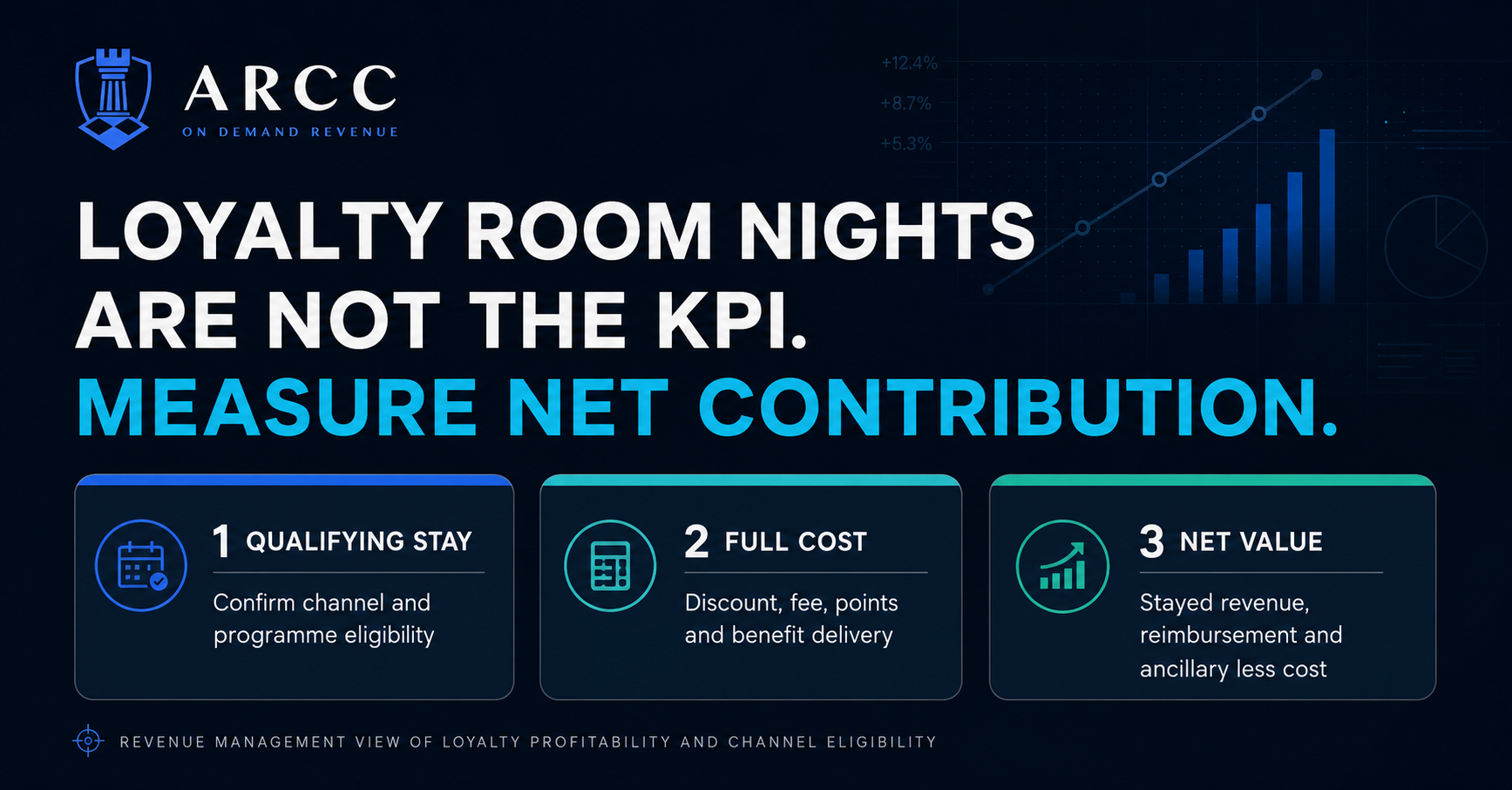
Answer in brief: Revenue managers should not use member penetration or global membership as proof of loyalty profitability. Measure qualifying stayed room nights, like-for-like member ADR, programme and acquisition charges, benefit delivery, reward-stay reimbursement, ancillary spend and date-level displacement. Then compare net contribution with equivalent non-member and alternative-channel demand.
Key takeaways
- An enrolled guest is not automatically a qualifying loyalty stay.
- Major programmes often exclude OTA and other third-party bookings from points, elite-night credit and guaranteed benefits.
- Member room nights and direct room nights are different datasets.
- Use actual programme invoices and contract schedules rather than generic loyalty-fee percentages.
- Reward reimbursement and availability rules vary by programme.
- Benefit cost should be measured from hotel operating data, not internet estimates.
- Net contribution should be analysed by tier, booking channel, rate plan, source market and stay date.
- Loyalty can be profitable, neutral or value-destructive depending on the property and the booking.
Start with eligibility
The original draft treated any booking made by an enrolled member as a loyalty booking.
That is incorrect.
Programme rules define which rates and channels qualify.
Hilton states that members booking through a third-party website do not earn points, stay or night credit or additional Hilton Honors benefits.
IHG states that most rates booked through third-party websites are not qualifying rates.
World of Hyatt excludes rooms booked through third-party online retailers from eligible rates.
The operational treatment may vary by programme, hotel and circumstance, but the revenue report must distinguish:
- qualifying paid stay;
- reward stay;
- points-and-cash stay;
- approved travel-agent or GDS stay;
- non-qualifying OTA stay;
- wholesale or package stay;
- group stay; and
- enrolled guest with no programme entitlement on that booking.
Do not apply loyalty charges or benefit assumptions to a booking unless the contract and programme rules support them.
Scale is context, not a revenue-management KPI
Marriott reported nearly 283 million Bonvoy members at the end of Q1 2026. Hilton reported 251 million Honors members at 31 March. IHG One Rewards reports more than 160 million.
CBRE found that loyalty members contributed 52.8% of occupied rooms in the public-company data it reviewed for 2024.
Those figures explain why loyalty matters.
They do not answer:
- which members book this hotel;
- how often;
- at what ADR;
- through which channel;
- under which rate;
- with which benefits;
- at which dates; or
- at what net contribution.
Revenue management begins at the property and stay level.
Six metrics that matter
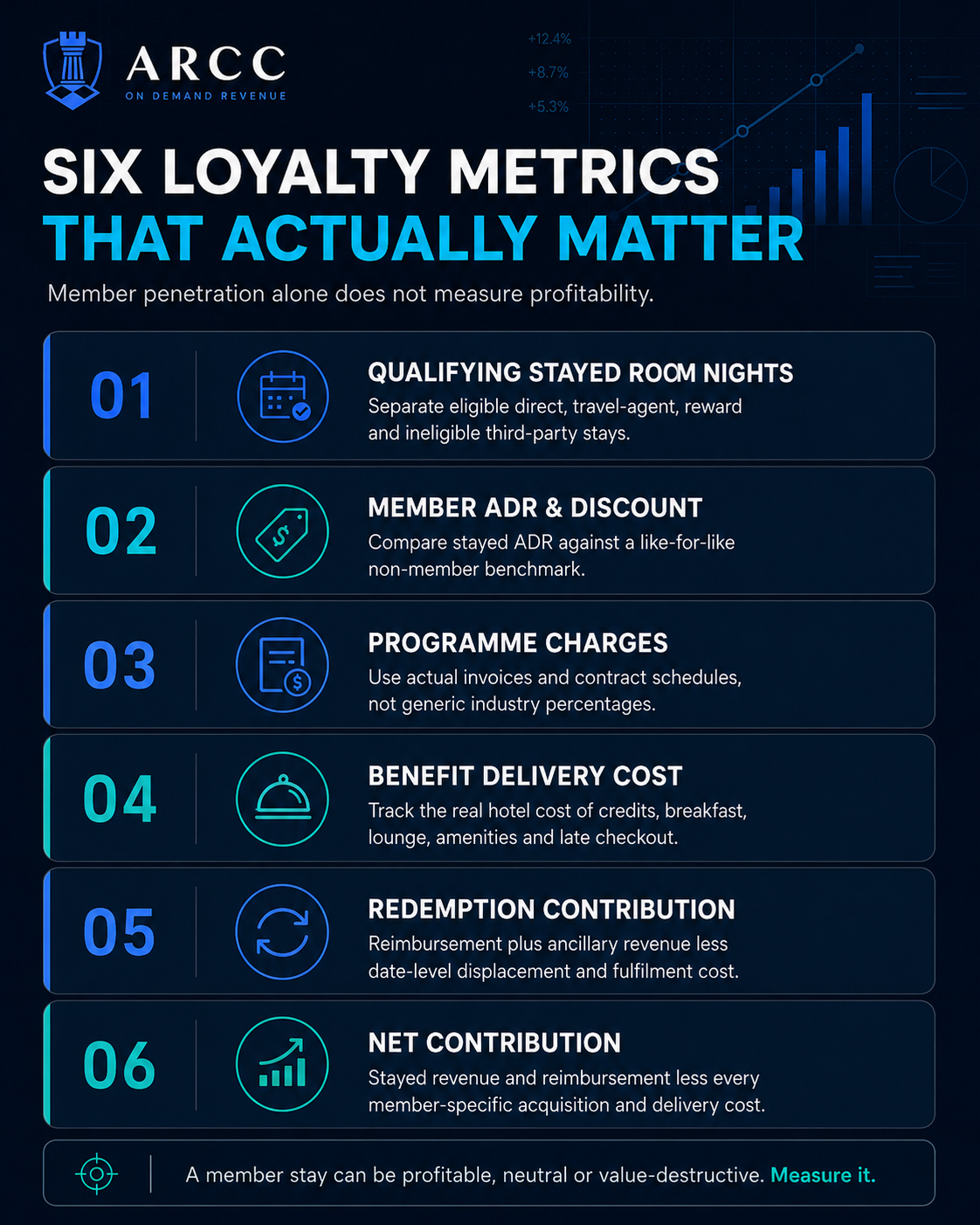
1. Qualifying stayed room nights
Use stayed production, not bookings created.
Separate:
- cancelled bookings;
- no-shows;
- reward nights;
- points-and-cash;
- qualifying paid stays;
- eligible travel-agent or GDS stays; and
- ineligible third-party stays.
The report should reconcile with the brand's programme billing.
2. Like-for-like member ADR
Do not compare all members with all non-members.
Control for:
- date;
- room type;
- length of stay;
- cancellation terms;
- lead time;
- segment;
- package inclusions;
- source market; and
- booking channel.
A member-rate discount may still generate stronger contribution if it replaces higher-cost OTA demand or fills weak periods.
It may destroy value if it discounts demand that would have booked at BAR.
3. Programme and acquisition charges
Use actual property data for:
- loyalty or participation charges;
- points-related charges;
- reservation fees;
- payment cost;
- travel-agent or GDS cost;
- direct media;
- call-centre charges; and
- any applicable channel commission.
An indicative loyalty assessment range of 1% to 3% of qualifying room revenue is commonly cited for some major programmes. Use it only as a preliminary planning assumption. Actual contracts may charge different percentages, use different revenue definitions or separate points, reservation and programme fees.
Do not assume one universal loyalty-fee percentage.
Do not assume a third-party booking carries loyalty charges unless the relevant agreement shows that it does.
4. Benefit delivery cost
Track actual cost by tier and property.
Possible components include:
- food and beverage credit;
- breakfast;
- lounge;
- welcome amenity;
- points compensation;
- upgrade displacement;
- late checkout;
- housekeeping impact; and
- staff time.
Use incremental cost where appropriate.
Do not automatically value a complimentary breakfast at menu price or a suite upgrade at the full published rate. The relevant economic cost depends on occupancy, sell-out probability, food cost, labour and displaced demand.
5. Reward-stay contribution
For each reward night, record:
- reimbursement received;
- occupied-room variable cost;
- ancillary revenue;
- benefit delivery;
- date and room type;
- hotel occupancy;
- comparable paid ADR;
- whether the hotel sold out; and
- demand that was actually displaced.
Industry experience and current owner complaints show that reward reimbursement frequently runs below commercial ADR. Many programmes increase reimbursement at defined high-occupancy thresholds, but that does not remove the need to test the remaining gap against the paid rate the hotel could reasonably have sold.
A reward stay on a low-demand night may be strongly positive.
A reward stay on a compressed date may carry material opportunity cost even where reimbursement steps up.
Availability and inventory controls vary. Some contracts or programmes provide tools around standard-room inventory, exceptional dates or limited blackout provisions. Others restrict property discretion. Hilton states that reward stays are not subject to blackout dates or capacity controls. Marriott describes a limited-blackout policy. Revenue managers must use the actual programme rules rather than assume they can close reward inventory, change the points requirement or renegotiate reimbursement.
6. Net contribution
A practical formula is:
Net loyalty contribution = stayed room revenue plus reward reimbursement plus attributable ancillary contribution, minus member discount, programme and acquisition charges, benefit delivery, payment cost, incremental fulfilment cost and credible displacement.
Compare the result with:
- comparable non-member direct demand;
- OTA;
- corporate;
- wholesale;
- group; and
- the next-best demand the hotel could have accepted.
Member penetration can rise while value falls
Member penetration is a mix metric.
It can increase because:
- direct conversion improved;
- the brand delivered incremental demand;
- the hotel enrolled more guests;
- OTA demand migrated to brand.com;
- non-member demand weakened;
- the member discount increased; or
- more low-value stays were classified as member production.
The percentage alone does not explain the outcome.
Report member penetration with:
- net ADR;
- net contribution;
- acquisition cost;
- tier mix;
- source market;
- cancellation;
- length of stay;
- ancillary spend; and
- repeat frequency.
Elite qualification changes require modelling
Hilton changed its qualification structure from January 2026.
Gold now requires 25 nights, 15 stays or USD 6,000 eligible spend. Diamond requires 50 nights, 25 stays or USD 11,500 eligible spend. Diamond Reserve requires 80 nights and USD 18,000 eligible spend.
These changes may alter:
- elite population;
- benefit expectations;
- tier mix;
- property cost;
- stay concentration; and
- member behaviour.
The revenue manager should not assume that lower night thresholds automatically produce higher cost.
Track the actual property effect.
Loyalty and direct are not interchangeable
A qualifying loyalty stay can arrive through:
- the brand website;
- the brand app;
- the hotel;
- the brand call centre;
- an approved travel agent; or
- an eligible GDS path, depending on programme rules.
A direct booking can also be non-member.
An enrolled guest booking through an OTA may be ineligible for points and elite benefits.
Therefore maintain separate dimensions for:
- booking channel;
- programme eligibility;
- member tier;
- rate plan; and
- benefit delivery.
This prevents the hotel from incorrectly attributing OTA commission, loyalty fees and benefits to the same stay.
The monthly loyalty report
| Field | Required view |
|---|---|
| Qualifying paid room nights | By tier, channel and source market |
| Reward room nights | By date, room type and occupancy |
| Stayed member ADR | Like-for-like against non-member ADR |
| Member discount | Realised discount against relevant reference rate |
| Programme charges | Actual invoiced amount |
| Benefit cost | Actual hotel cost by tier |
| Reimbursement | Actual reward-stay receipts |
| Ancillary contribution | F&B, spa, upgrades and other spend |
| Net contribution | By tier, channel, rate and date |
| Repeat behaviour | Return to the same property where data permits |
What the industry data says
CBRE's 2024 analysis found that:
- membership across five public hotel companies increased by 14.5%;
- members accounted for 52.8% of occupied rooms in the available public-company data;
- average room nights per member declined to 1.0;
- loyalty fees increased faster than revenue; and
- cost remained relatively modest overall at USD 5.46 per occupied room or 1.6% of total revenue in the relevant U.S. dataset.
This is a balanced result.
Loyalty programmes generate significant demand and can be cost-effective.
They also require property-level measurement as membership broadens and more members enter through cards and partnerships rather than frequent hotel stays.
What to do when performance is weak
Do not immediately conclude that the programme is bad.
Diagnose the cause.
Discount leakage
Member discounts are applied to demand that would have paid a higher rate.
Wrong channel mix
Eligible direct member production is weaker than expected, while high-cost channels dominate.
Benefit delivery
The property is delivering benefits inefficiently or incorrectly valuing their economic cost.
Reward displacement
Reward nights are concentrated on dates where the hotel could have sold the room.
Market mismatch
The programme's active member base does not align with the hotel's demand markets and positioning.
Reporting failure
Costs and production are spread across systems and departments, preventing one reconciled view.
The response may involve:
- pricing;
- availability;
- staff training;
- benefit execution;
- source-market strategy;
- data reconciliation;
- operator escalation; or
- owner-level HMA and brand review.
Does an OTA booking from a loyalty member earn points and benefits?
Often not. Hilton explicitly excludes third-party website bookings from points, stay credit and additional member benefits. IHG and Hyatt also exclude most third-party online rates. Check the relevant programme rules.
Should menu price be used as the cost of complimentary breakfast?
Usually no. Measure incremental food, beverage and labour cost, plus any credible displacement.
Is reward reimbursement normally below commercial ADR?
Frequently, yes, particularly under lower-occupancy reimbursement formulas. Payments may increase once the hotel reaches defined occupancy thresholds, but the reimbursement can still remain below the commercial rate available on the date. Compare actual reimbursement, ancillary spend, fulfilment cost and credible displaced demand.
Is member ADR normally higher?
It can be higher or lower depending on tier, segment, discount, source market and hotel. Measure it rather than assume it.
Who should own the analysis?
Revenue management should lead the commercial model with finance, front office, F&B, loyalty or brand contacts and asset management.
Conclusion
The loyalty programme is not one channel and not one cost.
It is a set of qualifying rules, discounts, fees, benefits, reimbursements and demand behaviours.
The revenue manager's job is not to maximise member room nights.
It is to maximise the net contribution of the demand the hotel accepts.
Measure the booking correctly.
Measure the cost completely.
Then decide whether loyalty is creating value for this hotel.
Related owner-side analysis
Read Signa Hotel Advisors' companion article: Hotel Loyalty Programmes: What Owners Need to Test Before Signing
Sources and methodology
Facts were reviewed on 23 June 2026.
- Marriott Q1 2026 results
- Hilton May 2026 investor presentation
- IHG One Rewards owner value
- CBRE: Loyalty programmes continue to prove value
- CBRE: Benefits and costs continue to rise
- Hilton third-party booking eligibility
- IHG qualifying-rate guidance
- World of Hyatt eligible-rate rules
- Hilton Honors 2026 tier changes
- The Wall Street Journal: Marriott owner reimbursement dispute
- Hilton Honors programme terms: reward availability
- Marriott Bonvoy: limited blackout dates
ARCC Group provides outsourced hotel revenue management, distribution strategy and commercial performance support across Southeast Asia and Europe.
Explore more from ARCC: try our free revenue calculator, review our revenue management services, or get in touch.
Written by ARCC Group
Revenue management consultancy serving independent and boutique hotels across Southeast Asia. arcconsulting.io
You might also like
How to Build a Realistic Rooms Revenue Budget for an Independent Hotel
Build a practical annual rooms revenue budget for an independent Thai hotel, using actuals, booking pace, segment mix, seasonal demand and net revenue.
7 Hotel Budget Mistakes Owners Should Challenge Before Signing Off
Before approving an annual hotel budget, challenge the assumptions behind growth, commission, segment mix, occupancy, ADR, market share and reforecasting.