The Constraint Is Capture: F&B Revenue Management for Thai Hotels and Resorts
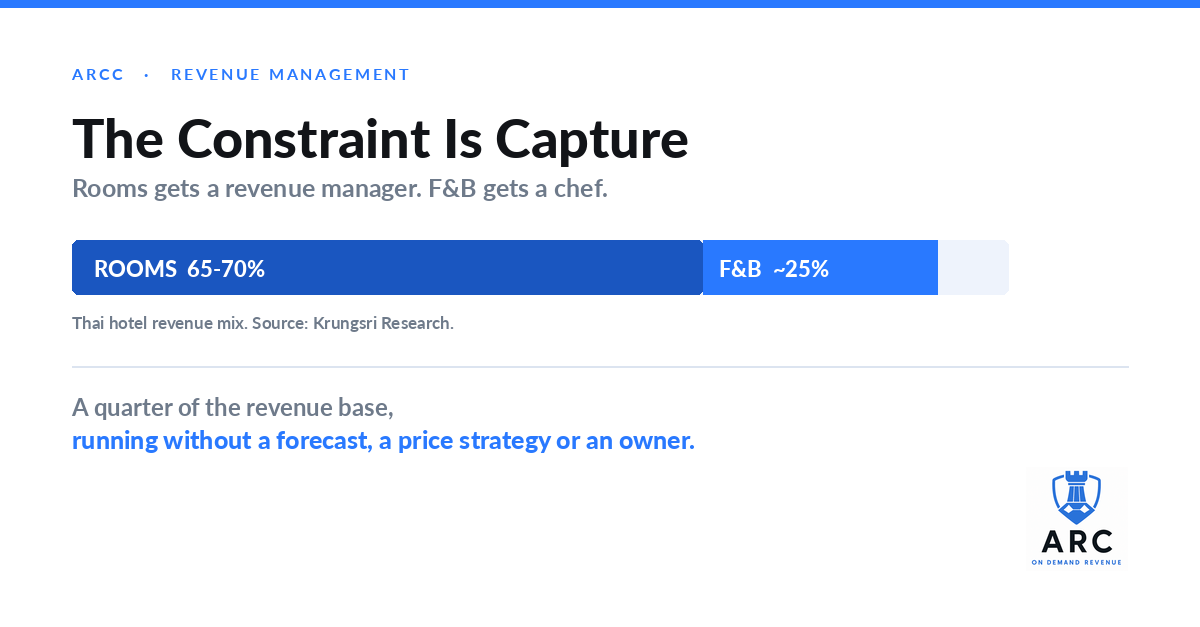
Answer in brief: Most Thai hotels manage food and beverage as a kitchen with a P&L attached. Rooms get a forecast, a pricing strategy, a segmentation model and a dedicated manager. F&B gets a menu and a headcount. That gap is why F&B sits at around a quarter of Thai hotel revenue and contributes far less than it should. The fix is not more seats. It is measuring capture rate, revenue per available seat hour and contribution per cover, then pricing and staffing against a forecast the way rooms already does.
Key takeaways
- Food and beverage accounts for roughly 25% of Thai hotel revenue, with rooms at 65% to 70%, according to Krungsri Research. Four and five star properties skew higher.
- Almost none of that 25% is actively revenue managed.
- Capture rate, not covers, is the first number to fix. It tells you what share of in-house guests are eating on property and where you are losing them.
- RevPASH, revenue per available seat hour, is to an outlet what RevPAR is to a floor of rooms. Most Thai properties have never calculated it.
- Weekend-weighted demand, common across Pattaya and the Eastern Seaboard, means an outlet sized for Saturday is idle Tuesday and carries its cost base all week. That is a rostering and pricing problem, not a design problem.
- Ancillary revenue extends beyond F&B. Upsells at the point of confirmation and check-in convert against a guest who has already decided to come.
- ARCC runs Perfect Check for F&B revenue management and holds the Thailand licence for Upsell Guru.
Rooms gets a revenue manager. F&B gets a chef.
Walk into most Thai hotels and ask who owns the F&B number.
You will usually be pointed at the executive chef or the F&B manager. Both are operators. Both are measured on cost of goods, labour percentage and guest satisfaction. Neither has a demand forecast, a pricing calendar, a segmentation model or a daily pickup report.
Now ask the same question about rooms. There is a revenue manager, a forecast, a competitive set, a rate strategy by day of week and season, channel-level performance data and a weekly commercial meeting.
Same building. Same guests. One department is managed commercially and the other is managed operationally.
That is the whole gap. A quarter of the revenue base running without the discipline applied to the other two thirds.
Start with capture rate, not covers
Covers is a volume number. It tells you how many people ate. It does not tell you whether that was good.
Capture rate tells you what proportion of in-house guests ate on property, by meal period. It is the single most diagnostic number in hotel F&B, and it exposes problems that a covers count hides completely.
A property might run strong breakfast capture, which is usually a package artefact rather than an achievement, and then lose almost everyone at dinner. The covers report looks acceptable because breakfast carries it. The capture report shows a property that has the guest on site all day and monetises one meal.
Once capture is measured by meal period, the diagnosis becomes specific:
- Weak lunch capture usually means the guest is out, or the offer is wrong for a poolside occasion.
- Weak dinner capture in a Thai beach resort usually means price. The guest can eat well for a fraction of the outlet price a short walk from the gate.
- Weak beverage capture with strong food capture usually means service flow and menu structure, not demand.
- Strong capture with weak average check means the mix is wrong, not the traffic.
Each of those has a different fix. None of them is more seating.
RevPASH is the metric the outlet has been missing
Rooms revenue management works because it has a unit that combines price and utilisation. RevPAR does not let a manager hide behind occupancy or behind rate.
F&B has the same metric available and almost nobody in this market uses it. Revenue per available seat hour takes outlet revenue and divides it by seats multiplied by trading hours.
It changes decisions immediately, because it makes the two hidden costs visible.
An outlet that opens for eleven hours to serve a three-hour dinner peak is destroying its own RevPASH. So is an outlet with sixty covers of capacity that never exceeds twenty five. Both look fine on a covers report and a food cost percentage. Both are quietly consuming labour, energy and space.
The fixes that follow from a RevPASH view are usually cheap:
- shorten trading hours in low season rather than staffing an empty room
- consolidate two weak outlets into one strong one during the trough
- reprice or re-time the menu around the actual demand curve
- turn tables faster at peak with a different service sequence
- add a limited grab-and-go format for the periods that cannot support full service
None of that is capital expenditure. All of it lands on contribution within a quarter.

Menu engineering is pricing, and pricing is revenue management
Every menu is a rate structure. Most Thai hotel menus are priced by adding a margin to food cost and rounding.
Proper menu engineering plots each item by contribution margin and popularity, then acts on the four quadrants. High margin and popular items get position, description and staff push. High margin and unpopular items get repositioned or re-described. Low margin and popular items get reworked or repriced. Low margin and unpopular items come off.
That is exactly what a revenue manager does with room types and rate plans, applied to a different inventory.
Perfect Check exists to run this properly. It was built by one of ARCC's own co-founders, from the same view that F&B is an unmanaged revenue centre rather than a cost centre with a menu. ARCC deploys it as part of commercial mandates rather than selling it as software and walking away.

Forecast the covers, then roster to the forecast
Labour is the largest controllable line in F&B and the one most often set by habit.
A property with weekend-weighted demand, which describes most of the Pattaya and Jomtien market, will typically roster a flat week. Saturday is under-staffed and service quality drops. Tuesday is over-staffed and contribution leaks all day.
The correction is the same discipline rooms uses. Forecast covers by day and meal period from in-house guest count, capture rate assumptions, arrivals pattern and event calendar. Roster against that forecast. Review variance weekly.
Properties that do this typically find the labour saving alone pays for the exercise, before any revenue upside.
Ancillary revenue is not only F&B
The same logic applies to everything the guest can buy that is not the room.
Upselling at the point of booking confirmation and at check-in works because it targets a guest who has already committed. They have paid, they are arriving, and the decision in front of them is small. Room upgrades, early check-in, late check-out, breakfast, transfers and experiences all convert at rates that surprise operators who have only ever tried to upsell at the front desk under pressure.
ARCC holds the Thailand licence for Upsell Guru, which automates that process across the pre-arrival window, and we run it alongside the F&B work because the two share a denominator. Both are about extracting more contribution from a guest who is already coming, rather than buying a new one.
That is a materially cheaper form of growth than either discounting rooms or building an outlet.
What good looks like
A property running F&B commercially has, at minimum:
- capture rate tracked by outlet and meal period, split weekday and weekend
- RevPASH by outlet, reviewed monthly against trading hours
- a covers forecast driven by in-house guest count and arrivals pattern
- rosters built against the forecast rather than a fixed template
- menu items plotted by contribution margin and popularity, reviewed at least twice a year
- average check tracked by source market rather than blended
- external versus in-house revenue split by outlet
- a commercial meeting where the F&B number is discussed with the same seriousness as the rooms number
Very few properties in this market have all eight. Most have none of them.
The owner-side view
Signa Hotel Advisors published a companion analysis of the same problem from the ownership perspective, looking at why adding outlets rarely fixes a contribution problem and why the capital would often earn more elsewhere on the site.
Read it here: https://signahoteladvisors.com/insights/hotel-dwell-time-southeast-asia-owner-economics
The two pieces reach the same conclusion from different ends. An owner should not sign off new F&B capacity before the existing capacity has been managed properly, because the second exercise is far cheaper and usually recovers more.
Frequently asked questions
What is capture rate in hotel F&B?
The proportion of in-house guests who eat or drink at the property's outlets, measured by meal period. It is calculated as covers from in-house guests divided by guests in house. It is more diagnostic than a covers count because it separates a demand problem from an occupancy problem.
What is RevPASH?
Revenue per available seat hour. Outlet revenue divided by seats multiplied by trading hours. It is the F&B equivalent of RevPAR, and it exposes both under-utilised capacity and over-extended trading hours, neither of which shows up in a covers report.
How much of a Thai hotel's revenue comes from F&B?
Around 25%, with rooms at 65% to 70% and other sources at 5% to 10%, according to Krungsri Research. Four and five star properties generally run a higher F&B share.
Can F&B revenue management work in a small resort?
Yes, and the returns are often faster because the base is unmanaged. A 40 to 60 key resort with two outlets can usually be assessed and restructured inside a quarter, with rostering and trading hours delivering results before any menu or pricing change.
Is this the same as menu engineering?
Menu engineering is one component. Full F&B revenue management also covers capture rate management, covers forecasting, trading hour optimisation, seat utilisation, labour rostering against forecast, and pricing by day part and season.
What is Perfect Check?
An F&B revenue management platform built by one of ARCC's co-founders, designed to manage outlets as revenue centres rather than cost centres. ARCC deploys it within commercial mandates rather than as standalone software.
What is Upsell Guru?
An automated pre-arrival and check-in upselling platform. ARCC holds the Thailand licence and runs it alongside F&B and rooms revenue management, because all three draw contribution from a guest who has already booked.
Explore more from ARCC: try our free revenue calculator, review our revenue management services, or get in touch.
Written by ARCC Group
Revenue management consultancy serving independent and boutique hotels across Southeast Asia. arcconsulting.io
You might also like
How to Build a Realistic Rooms Revenue Budget for an Independent Hotel
Build a practical annual rooms revenue budget for an independent Thai hotel, using actuals, booking pace, segment mix, seasonal demand and net revenue.
7 Hotel Budget Mistakes Owners Should Challenge Before Signing Off
Before approving an annual hotel budget, challenge the assumptions behind growth, commission, segment mix, occupancy, ADR, market share and reforecasting.